
Most of us would agree that receiving a stable salary is very important to every employee. However, questions often arise when employees receive their payslip and notice that the amount paid differs from what they initially expected. In this article, we review the main factors that can affect monthly pay and explain why the salary received may not always match the amount specified in the employment contract.
Application of the Tax-Exempt Amount of Income (TEA)
Employees have the right to decide whether the Tax-Exempt Amount of Income (TEA) should be applied when their salary is calculated each month or whether it should be claimed through their annual personal income tax (PIT) return declaration. When the TEA is applied on a monthly basis, the employee receives a higher net salary because PIT is not calculated on the portion of income covered by the TEA.
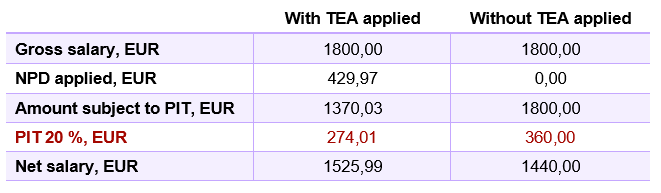
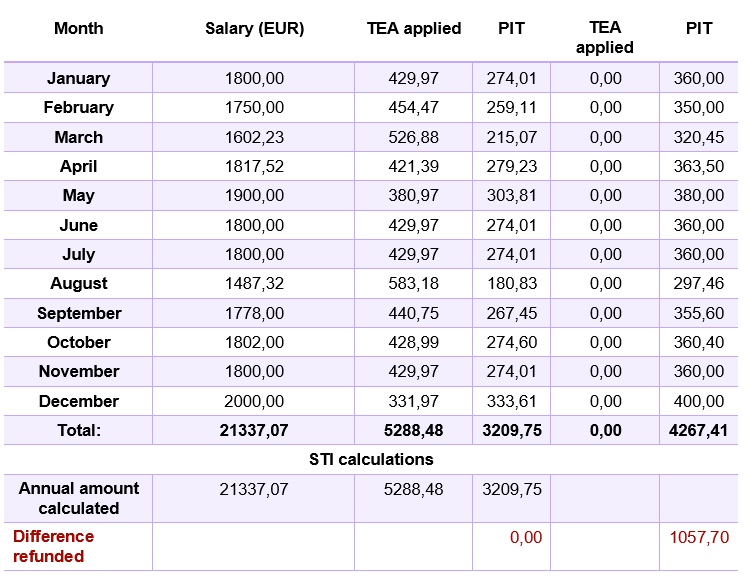
It is important to note that employees do not lose the benefit of the TEA if it is not applied during the year. After the end of the calendar year, the State Tax Inspectorate (STI) recalculates PIT based on the employee’s total annual income and, where applicable, refunds any overpaid PIT. As a result, the difference lies only in when the employee receives the benefit: either through a higher net salary each month or as a refund after filing the annual PIT return.
Participation in Additional Pension Savings
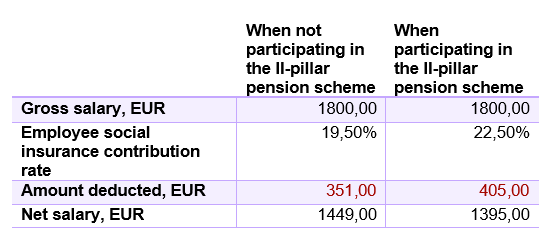
Employees may also participate in Lithuania’s second-pillar pension scheme and contribute towards additional retirement savings. In such cases, an additional 3 % contribution is deducted from the employee’s gross salary and transferred to the State Social Insurance Fund Board under the Ministry of Social Security and Labour (Sodra). As a result, employees participating in the scheme should expect a lower net salary, as the additional 3 % of pension contribution is withheld from their monthly pay.
Social Security Contribution Ceilings and Applicable PIT Rates
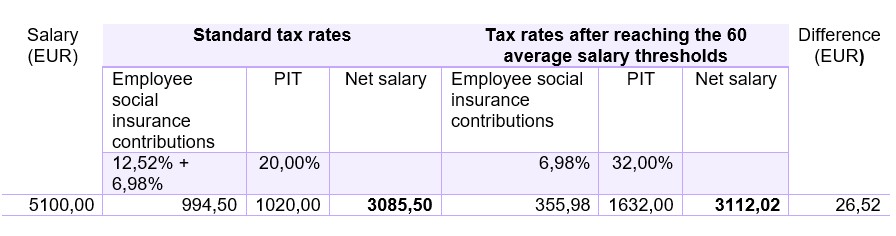
Employees earning higher monthly income should be aware that, once the Sodra contribution ceiling is reached, namely the 60 national average monthly salary threshold (138 729 EUR in 2026), State Social Insurance (SSI) contributions are no longer calculated. As a result, the social insurance contribution rate of 19,5% (or 22,5% for employees participating in the second-pillar pension scheme) decreases to 6,98%, as only Compulsory Health Insurance (CHI) contributions continue to apply.
At the same time, the PIT rate applicable to the portion of income exceeding the statutory threshold increases to 32%. Employees may choose whether the additional 12% PIT rate should be applied each month or whether any resulting PIT liability should be settled when filing their annual PIT return.
It is also important to note that, from 2026, a new 25 % PIT rate is introduced. This rate becomes applicable once an employee's annual employment income reaches 36 average monthly salaries (83 237,40 EUR in 2026. Employees may choose whether this rate should be applied through monthly payroll calculations or whether any resulting PIT liability should be settled when filing their annual PIT return. Unlike the 60 average monthly salary threshold, reaching the 36 average monthly salary threshold does not affect the applicable social insurance contribution rates.
Payment for Annual Leave and Additional Rest Days for Parents
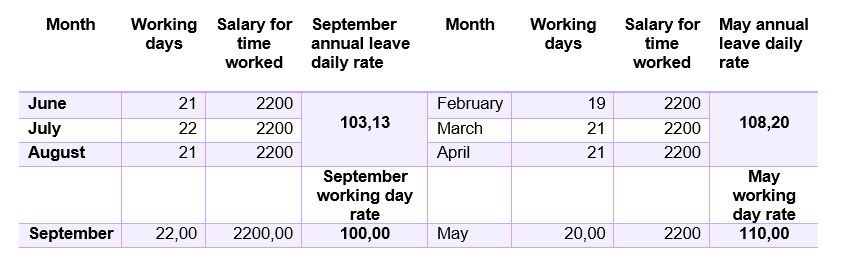
Payment for annual leave and additional rest days for parents is calculated based on the employee’s average salary. Average salary is determined by taking into account the employee’s remuneration accrued and the number of working days worked during the three months preceding the month in which the annual leave or additional rest day is taken.
It is important to note that the calculation is based not only on the employee’s base salary for time worked, but also includes annual, semi-annual and quarterly bonuses, performance-related bonuses, as well as remuneration for overtime, night work, and work performed on rest days or public holidays.
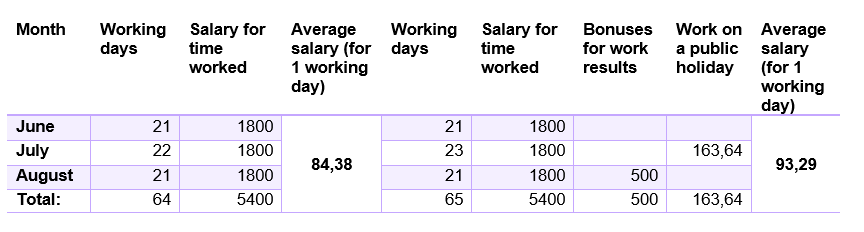
Since the number of working days differs each month and employees may receive various bonuses or additional payments, the daily rate calculated based on average earnings may differ from the daily rate calculated based on the salary set out in the employment contract. Therefore, the amount payable for annual leave or additional rest days for parents may be higher or lower, meaning that the salary received in a particular month may differ from the employee’s usual monthly pay.
Payment During Employee Sickness Leave
Employers pay sickness leave benefits only for the first two days of sickness absence that coincide with the employee's work schedule. If, for example, an employee is absent due to illness for five working days, the employer will pay sickness benefits only for the first two days, provided they fall within the employee's work schedule, while the benefits for the remaining days will be paid by Sodra. As a result, the employee's salary for that month is usually lower than their regular salary.
It is also important to note that, in the case of caring for a sick family member, the benefit is paid by Sodra from the first day.
The amount of sickness leave benefit paid by the employer for the first two days of sickness absence depends on the company's internal policy. However, under Lithuanian legislation, it cannot be lower than 62,06% and cannot exceed 100 % of the employee's average salary.
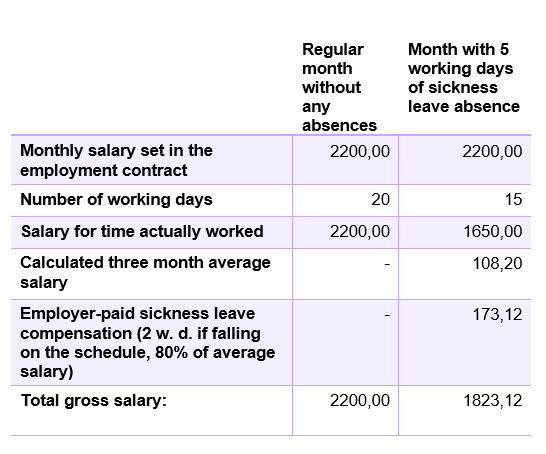
Although the salary specified in the employment contract may remain unchanged for a long period of time, the final net amount received by an employee may vary due to different tax, social insurance and payroll calculation factors. Understanding how these factors affect salary calculations can help employees better understand the information shown on their payslip and the reasons why the amount received may occasionally differ from their usual salary.