In business operations, situations frequently arise where workload increases, either temporarily or over a longer period. This may be caused by employee absences due to annual leave, the implementation of new projects, seasonal demands in business activity, or other operational circumstances. To ensure smooth work allocation and business continuity, employers may rely on various work organization solutions. As demonstrated by the case law of the Supreme Court of Lithuania, the legal classification of work exceeding the normal workload depends on the specific circumstances of each case. Therefore, it is important for employers to understand the available ways of properly formalising such work arrangements.
I. Overtime Work
Overtime work is the time during which an employee actually works beyond the daily (shift) working hours or the total working time established for the relevant reference period under the employee’s working time regime. For example, if an employee's normal working hours are from 8:00 a.m. to 5:00 p.m., but at the employer's request the employee works an additional three hours on a particular day, those extra hours will be considered overtime.
As a rule, overtime may be assigned only with the employee’s written consent, except in the exceptional cases expressly provided by law. The employee's consent should be obtained for each specific instance of overtime work. In practice, such consent is usually provided through a manually signed document, an email, or another written form that clearly demonstrates the employee’s intention to agree to the specific overtime work.
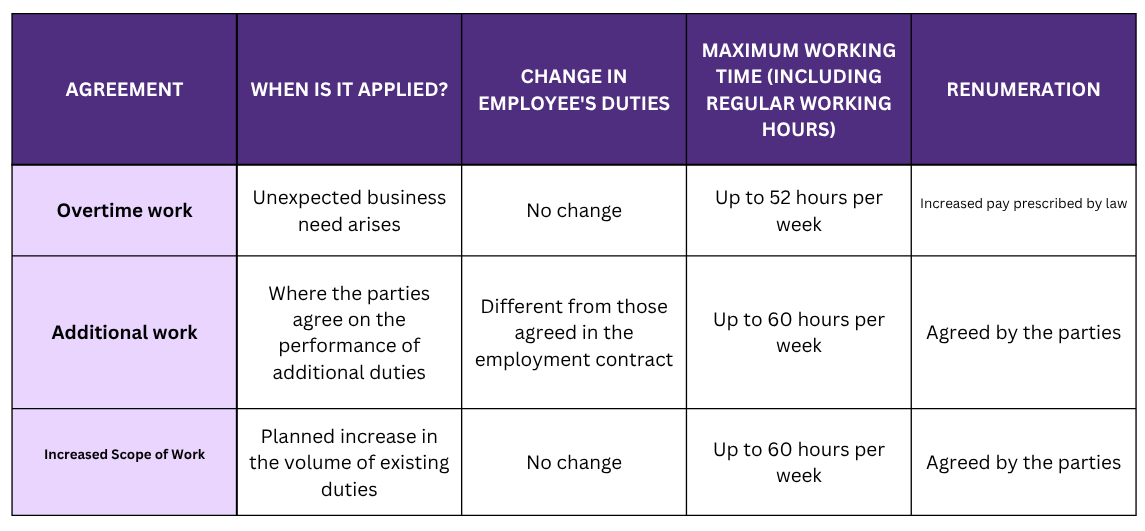
Overtime work may not exceed eight hours per week. However, with the employee’s consent, this limit may be increased to twelve hours per week. In addition, overtime work is subject to the increased remuneration established by law, meaning that employees must be paid at a rate of no less than one and a half times their regular salary for hours worked overtime.
It is important to note that overtime should not be used as a permanent work organisation tool. It is intended only for exceptional and temporary situations, such as covering for a colleague who unexpectedly falls ill. Therefore, if it is known in advance that the workload will increase for a longer period, for example, when replacing an employee during a planned one week vacation or when implementing a project that is expected to require additional work, employers should consider alternative work organisation agreements.
II. Agreement on Additional Work
Additional work is formalised through a separate agreement attached to the employment contract. Under such an agreement, an employee performs additional functions of a permanent nature within the same workplace that were not previously agreed upon in the employment contract. The performance of new job functions is the key characteristic distinguishing this agreement from other workload management methods. For example, if an employee works as a sales manager and the employer additionally requests that the employee perform marketing specialist duties, an agreement on additional work should be concluded.
In practice, additional work may be performed in various ways: outside the employee’s regular working hours, simultaneously with the employee’s main duties, or as part of a specific project. Therefore, the parties should clearly agree on the scope of the additional functions, the manner in which they will be performed, and the remuneration for such work. It should be noted that additional work is generally need to be recorded separately in working time records, unless the additional functions are performed simultaneously with the employee’s primary duties.
The performance of additional work does not create an exception to working time requirements. The employee’s total working time, including both overtime and additional work, may not exceed twelve hours per working day and sixty hours within any seven-day period.
III. Agreement on Increased Scope of Work
While overtime and additional work are generally well-known methods of managing increased workload, the concept of an increased scope of work still raises many practical questions. Although the Labour Code does not explicitly define this concept, its essential characteristics and application have been developed through court practice.
The defining feature of this agreement is that the employee continues to perform the same function agreed upon in the employment contract, but to a greater extent or with greater intensity.
Unlike in the case of additional work, no new functions are assigned to the employee. Furthermore, unlike overtime work, an increased scope of work is typically foreseeable and planned in advance. For example, an accountant may continue performing the same accounting duties but for a larger number of group companies, or an HR specialist may be responsible for administering significantly more employees than usual. In contrast to overtime work, an increased scope of work is compensated through additional remuneration agreed upon by the parties. The law does not prescribe a specific amount of such remuneration.
The parties should clearly agree in advance on the duration of the increased workload, its scope, and the additional compensation payable for it.
Conclusions
The distinction between additional work, overtime work, and an increased scope of work depends on the functions performed by the employee, the way the work is organised, and the remuneration agreements applicable to such work.
When determining which legal instrument should be applied, it is necessary to assess whether the increased workload is temporary or ongoing, whether the employee is assigned new functions or only the volume of existing duties increases, and what remuneration model is appropriate in the particular circumstances.
Proper application and documentation of these agreements help both employers and employees avoid labour disputes and breaches of labour law.